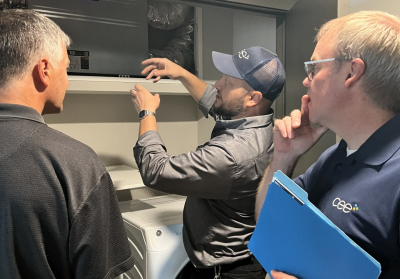
The Center for Sustainable Building Research (CSBR) at the University of Minnesota is celebrating 25 years of implementing B3 Guidelines for commercial buildings and the impact of the Sustainable Building 2030 (SB 2030) initiative, added to B3 in 2008. CEE has helped shape this program from the ground up as part of the original SB 2030 team. We recently renewed our contract with the program and will continue supporting SB 20230 with initiatives for improving energy efficiency standards in Minnesota. CEE’s engineering team will remain involved by reviewing energy modeling, conducting project plan reviews, guiding new cost-effective solutions, and refining standards.
SB 2030's origins and impact across the state
Since 2001, Minnesota has implemented a set of sustainable building guidelines to follow in the construction of new commercial buildings and major renovations to hit emission reduction goals. These regulations, called the B3 Guidelines, are required in commercial projects funded by the State of Minnesota through general obligation bonds and are encouraged for all construction projects. The B3 Guidelines improve sustainability and energy efficiency in new buildings through measurable performance-based, whole-building energy standards.
In 2008, the Minnesota Legislature appointed the Center for Sustainable Building Research at the University of Minnesota to form state-specific building energy performance targets. The Sustainable Building 2030 Energy Standard was built on the framework of Architecture 2030 and B3 Guidelines and was tailored to meet energy efficiency needs unique to Minnesota. From the beginning, CSBR has worked closely with CEE, Willdan, and LHB to refine standards every five years, innovate energy efficiency planning, and implement this ambitious program. The SB 2030 team aims to achieve net-zero emissions from commercial buildings by the year 2030.
Unlike standard energy codes, the B3 Guidelines and SB 2030 standards target energy performance improvements based on building type and size to meet efficient yet obtainable and cost-effective solutions. An energy modeling tool is then used to show what energy performance will be.
While SB 2030 has only been required for State bond-funded buildings, some municipalities have voluntarily opted into the program for comprehensive sustainability and modeling support. Cities like St. Paul and Edina have used SB 2030 as an overlay for their sustainable building requirements, and new buildings or major renovations may include SB 2030 when systems like lighting or HVAC are replaced. Thanks to its unmatched ability to pair advanced performance standards with cost-effectiveness, SB 2030 has made sustainability a reality in a growing number of commercial buildings in Minnesota.
Highlights from SB 2030 projects
- From 2008 to 2025, 371 buildings have been designed to meet the SB 2030 Energy Standard. These construction standards are predicted to save:
- 1,139 million kBtu/year
- 161,000 tons of CO2e/year
- $20.8 million in energy costs/year
- There are 325 SB 2030 projects currently in operation. Saving estimates through the end of 2025 are:
- 8,315 million kBtu
- 1,017,000 tons of avoided carbon
- $151.6 million in energy costs
SB 2030's future is bright and built to last
As we enter the next phase of SB 2030’s progress and impact, collaboration between members of the SB 2030 Consultant Team and Steering Committee will be critical to meet the goal of net-zero emissions.
Twenty-five years after the implementation of sustainable guidelines for new commercial buildings and renovations, the SB 2030 team continues to refine energy standards and the resources available for developers, engineers, municipalities, designers, and more. Thanks to the program team’s critical knowledge and experience with building performance, SB 2030 participants receive comprehensive support including software tools used for building energy simulation.
SB 2030 also requires all projects to remain cost-effective. CEE and other collaborators work with commercial design teams and property owners to determine the cost-effectiveness of energy efficiency measures while still ensuring that projects meet the required energy efficiency guidelines. Through this work, sustainable projects have remained accessible and ultimately saved millions of dollars in operating costs.
As key partners for the SB 2030 program, CEE’s engineering team has extensive experience with commercial building efficiency assessments, energy performance modeling, and plan reviews. We’re able to guide design and engineering teams and property owners to the most cost-effective sustainability solutions that will allow them to reap the benefits of improved building performance for decades.
Learn more about B3 operations and case studies
Contact Patrick Smith at the UMN Center for Sustainable Buildings
Contact Jett Roeser for more information about CEE's role in SB 2030