Hennepin County Residential Weatherization and Electrification Action Plan
Results
- Deploying weatherization and electrification measures across all homes is sufficient to reduce residential emissions roughly 74%–99% by 2050 in the modeled scenarios.
- Partial or full electrification paired with special utility rates and appropriate equipment choices can lower energy bills for most homes in Hennepin County.
- To align the residential sector with the County’s net-zero 2050 target, approximately 12,800 homes must be weatherized and electrified each year.
Highlights
Objectives
To understand the financial, labor, and emissions implications of weatherizing and electrifying all 1–4 unit homes in Hennepin County by 2050 and to identify actions the County can take to equitably accelerate this transition.
Scope
Analyzed all 1–4 unit homes in Hennepin County to evaluate decarbonization scenarios for the housing stock informed by local data, spatial analysis, stakeholder feedback, and an assessment of existing programs.
Benefits
Deploying a combination of weatherization, air source heat pumps, and heat pump water heaters across all homes can essentially decarbonize the residential sector in Hennepin County.
Project Background
Hennepin County is home to nearly a quarter of the population size of Minnesota. To meet the County’s climate goal of net-zero emissions by 2050, all homes in the county must be upgraded to eliminate carbon emissions. Weatherizing homes and replacing gas heating systems and appliances with efficient electric alternatives available on the market today creates a clear path to decarbonization, especially as Minnesota’s grid moves toward 100% carbon-free electricity by 2040. This study translated climate goals into project costs and building counts to understand what this transition will require.
Methodology
Center for Energy and Environment (CEE) developed an energy model of all residential 1–4 unit buildings in Hennepin County with representative accuracy down to the census tract level. Energy modeling scenarios, spatial analysis, and an overview of existing energy programs informed discussions with stakeholders and County staff to determine what actions would be most impactful in equitably decarbonizing residential properties. Read more about the research done to support this report here.
Findings
Modeling shows that three upgrades deliver nearly all the technically achievable greenhouse gas reductions in the studied housing stock: comprehensive weatherization, all-electric or dual fuel air source heat pumps, and heat pump water heaters. In each of the modeled scenarios, significant greenhouse gas emissions reductions would be achieved.
Modeled upfront costs, emissions reductions, and energy bill savings varied by scenario. One significant finding is that in all cases, Xcel Energy’s updated electric space heating rate significantly improves the affordability of home electrification.
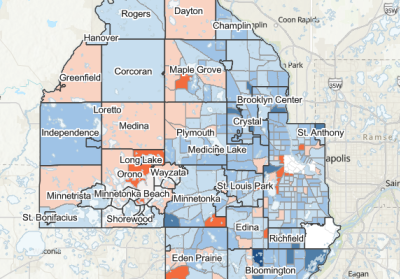
Spatial analysis also shows how the results of the study vary across the County. The need for weatherization is higher in older homes, often in more disadvantaged areas. Newer homes with sufficient insulation are ready to easily replace existing HVAC and appliances with electric options.
The plan presents a set of 10 recommended actions the county can take to facilitate weatherization and electrification projects, invest in high-impact programs, address barriers, and motivate action.