CEE and Daikin Applied tour showcases the market-moving power of strategic relationships
In a climate like Minnesota’s, where temperatures often drop below 0°F during the winter, 60% of the energy used in commercial buildings comes from heating, cooling, and ventilation, and 80% of commercial buildings in Minnesota use rooftop units (RTUs) for that heating and cooling. Almost all these RTUs are composed of outdated and less efficient components — only 0.5% of RTUs in the state use heat pumps and only 2% use energy recovery ventilators (ERVs). RTU heating efficiency has improved by a mere 1% in the last 30 years. This presents a huge opportunity to save energy and money by converting these units to highly efficient, next generation technology like heat pumps and ERVs, but progress can be slow when beliefs about older technology are entrenched and newer practices pose unknowns when it comes to installation, maintenance, and cost-parity. That is where strategic supply chain relationships, like the one between CEE and Daikin Applied, can move the needle.
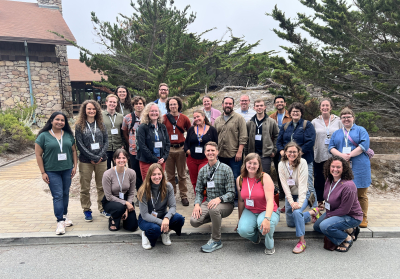
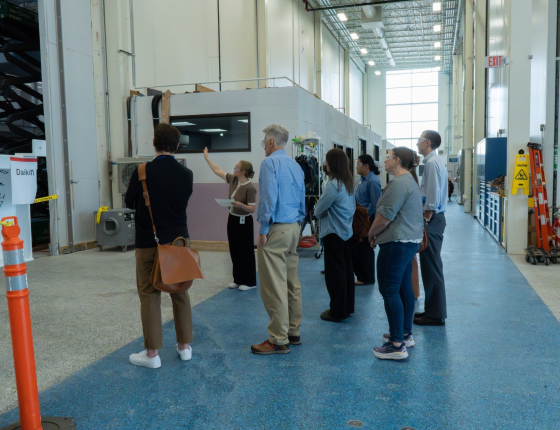
Recently, CEE and Daikin Applied co-hosted a presentation and tour for attendees of the National Association of Regulatory Utility Commissioners (NARUC) 2026 Summer Policy Summit. Utility commissioners and regulatory staff from across the country, as well as elected officials from Minnesota, heard from representatives of CEE and Daikin Applied about how this collaboration is shifting the market and bringing more efficient technology to more businesses and commercial buildings in the state.
Will Nissen, CEE’s director of policy, presented on Minnesota’s energy policy landscape and its long history of standard-based planning. The integrated gas and electric resource planning in the state and the Energy Conservation and Optimization (ECO) Act help the state meet standards cost-effectively. Fourteen percent of Minnesota’s electricity demand is met through utility efficiency programs, several of which are implemented by CEE.
Will was joined by colleague Isaac Smith, CEE’s director of market transformation technologies. Isaac delved deeper into Minnesota’s Efficient Technology Accelerator (ETA)*, a statewide market transformation program that accelerates deployment and reduces the cost of emerging and innovative efficient technologies. Isaac helped launch the Next Gen RTU initiative within the ETA portfolio, which promotes the adoption of heat pumps and ERVs in commercial buildings across the state. Isaac detailed the barriers to widespread adoption, including higher upfront costs and longer lead times for the products, established biases and a slow-to-change market, and low product awareness and confidence. Daikin and Next Gen RTUs have been working together to address these challenges by supporting field demonstrations, creating case studies showcasing the successful implementation of next gen RTU technology, and empowering contractors and other key market actors with training and maintenance resources and information about rebate programs.
The representative from Daikin Applied, Marcelo Minasi, senior director of engineering, echoed the efficacy of this collaboration with the Next Gen RTU initiative and explained several motivating factors have kept Daikin betting on Minnesota. Daikin Applied's commercial and industrial HVAC operations for North America are headquartered in Minnesota, where the company is making significant investments in advanced testing, training, and next generation heat pump technologies. That includes a combined investment of nearly $200 million in Plymouth: a $163 million R&D test lab that will let engineers test high-capacity heat pump technology in the coldest conditions, and a separate $30 million training institute with hands-on curriculum designed to address the skills gap that has trailed the recent advancement of HVAC technology. Both are slated to open in 2027. Together, CEE and Daikin Applied are helping overcome adoption barriers through technology validation, contractor training, field demonstrations, and education efforts designed to increase confidence in next generation systems.
With Daikin as a collaborator, the Next Gen RTU initiative is advocating for policies that will lower upfront costs and shaping rate design to reflect the decarbonization and efficiency gains of deploying more energy efficient RTUs. We are grateful to our collaborators at Daikin Applied and NARUC for helping us spread the word about how smart policy, advanced technology, and hands-on training can usher in a new age of building resilience and efficiency.
Learn more about CEE's policy work
*Minnesota's Efficient Technology Accelerator is a partnership funded by the state’s participating investor-owned utilities (IOUs) and consumer owned utilities (COUs), administered by the Minnesota Department of Commerce, Division of Energy Resources (DER), and implemented by Center for Energy and Environment (CEE).