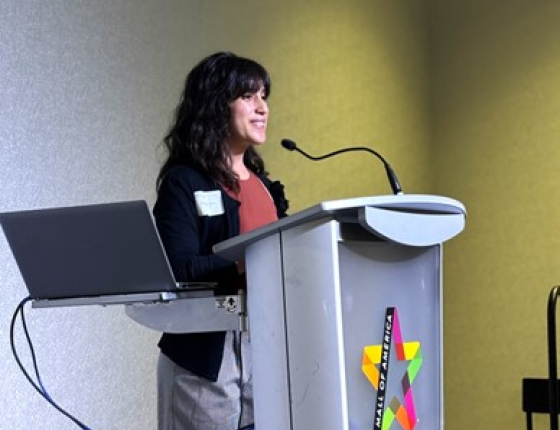
“Being from a warm climate, I've always loved being outside," said Ana De La Torre. Born in Mexico, her family moved to Oakdale, Minnesota when she was young.
"We weren’t used to the cold,” she said. “So, whenever there was a nice day, my mom would send us outside where we would play for hours. I developed this deep appreciation for the outdoors and the environment."
On graduating from high school, De La Torre enrolled with an undeclared major at Lake Forest College in Lake Forest, Illinois. As she began to learn about the natural disasters occurring because of climate change, her career aspirations shifted into focus. “It was this realization of, ‘We need to do something or we're going to destroy what we have,’” she said.
After receiving her bachelor’s degree in environmental studies, De La Torre took a position at Como Park Zoo and Conservatory in St. Paul. “I got to talk to people about plants and animals,” De La Torre said. “I would just be walking all day and chatting with people. As an extrovert who is passionate about nature, it was fantastic.”
About six months later, De La Torre signed on with Conservation Corps Minnesota and Iowa. She was placed at the Minnesota Department of Natural Resources, where she was soon hired full-time. The position allowed her to continue people-focused environmental work.
"It felt like my first big role in the field,” De La Torre said. Focusing on sustainability initiatives for state parks and trails, she spearheaded projects such as the creation of a fishing line recycling program and Hispanic community outreach efforts.
The role involved expanding equity in the use and enjoyment of state parks and trails, as De La Torre worked to translate written materials into Spanish. “It was really meaningful to be able to help make the representation that we see in our state parks actually look like the representation of Minnesota,” De La Torre said.
But as much as she enjoyed this work, the landscape beyond Minnesota beckoned. "At this point, I was young, in my early 20s, and I had this feeling of, ‘I want to see the world, and I need to do it before I have big responsibilities,’” De La Torre said.
She left her position at the DNR to travel the world. "I wanted to do it sustainably, as environmentally friendly as possible,” she said. “So, I started off by cycling around New Zealand for a year, then Southeast Asia for six months. I ended up settling down for a little while, working in Taiwan for a year and Australia for two years.”
De La Torre sought to connect her passion for the environment to her overseas adventures, often taking on short-term positions at locations like eco-resorts where she could offer her expertise. It only deepened her passion for environmental work.
On returning to Minnesota after six years of traveling, De La Torre took a position at the City of Saint Paul through the Green Corps and was later hired full-time as sustainability coordinator. After a year and a half, a peer at CEE, whom she’d collaborated with while working for the City, told her of a newly open position on the organization’s communities team.
In May 2024, De La Torre joined CEE as a community energy planner. In this role, she works directly with local governments in the Twin Cities metro area, developing energy action plans and assisting with implementation efforts.
So far, her proudest accomplishment is developing an energy action plan for the City of Vadnais Heights. “It’s the first city I've worked with as a lead, so I have been there from day zero all the way through the completion of their plan, and now I'm working on implementing the plan," De La Torre said.
The project began with planning and coordinating five community stakeholder workshops to identify the City’s energy priorities and goals. "Then, I took all of that information and turned it into a written plan,” De La Torre said. Now, she’s collaborating with City staff on implementation.
“I really enjoy seeing communities make real progress toward their energy goals,” De La Torre said. “Twice a year, we receive data that shows how the strategies we’ve created and implemented are helping each community reduce energy use and greenhouse gas emissions. Seeing the results makes the work feel meaningful and reinforces that what I do is contributing to a healthier, more sustainable world.”