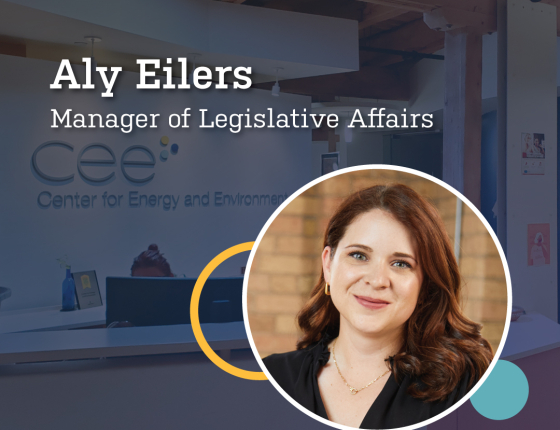
“Finding a balance of policy that is both durable and mission-driven is a constant push and pull,” said Aly Eilers, CEE’s manager of legislative affairs. “I find it invigorating.”
Since she was a young adult, Eilers has embraced the complicated, contentious arena of politics. After growing up in Princeton, Minnesota, she graduated from Bemidji State University with two bachelor’s degrees: international studies and political science.
“Right after graduating, I got hired as a campaign manager for a local state senator,” Eilers said. “It was nonstop work from June through November that culminated in his win. Experiencing that payoff was exhilarating.”
Eilers next took a position as a page at the Minnesota Senate, catapulting her into nearly a decade of work at the Senate that included stints as a legislative assistant, committee administrator on the Energy Committee, and researcher for issues relating to energy and the environment.
In October 2022, Eilers applied for and was offered the policy associate position at CEE after being encouraged by former staffer Jamie Fitzke, with whom she had collaborated closely during her time at the Senate.
"I had just had a baby in 2021,” Eilers said. “So, at that time, I was thinking about a couple of priorities — who would give me the best balance, and what issues did I most want to focus on moving forward?”
Feeling that CEE’s organizational culture was a strong fit, and that the position would allow her to fully tap into her growing interest in energy policy, Eilers accepted.
“I knew the reputation of CEE — it’s a really well-respected name and brand at the legislature,” she said. “It was honestly a no-brainer.”
As manager of legislative affairs, Eilers works closely with the director of policy and policy team members to develop CEE’s legislative strategies and priorities each year. She builds and maintains vital partnerships with external stakeholders to advocate for these policies leading up to and during the annual legislative session, representing CEE at stakeholder meetings and the legislature.
“Aly’s superpower is her ability to build relationships,” Will Nissen, CEE’s director of policy, said. “She excels at finding common ground and showing people the ways that good energy policy can help bolster their own goals. For example, while exploring ways to advance energy efficiency in manufactured homes, Aly built connections with people and organizations focused on other facets of manufactured housing policy in Minnesota. Those connections are now creating opportunities to move policy forward with diverse coalitions."
In her time at CEE, Eilers has drawn on this strength to help pass the 2024 Energy Conservation and Optimization (ECO) Act updates, as well as Minnesota’s nationally recognized data center bill in 2025.
The 2024 changes to ECO introduced a more practical regulatory approach to efficient fuel switching, or the replacement of a building technology like a home’s natural gas system with one that consumes a different fuel type, such as an electric air source heat pump.
Then, in summer 2024, CEE was asked to provide input and research on data center impacts and building efficiency by Energy Finance and Policy Committee Chair Patty Acomb, which grew into a wide-reaching bill that passed in 2025.
“We started with small group discussions, and our coalition grew as this piece of legislation got a foothold and grew legs,” Eilers said.
In collaboration with these stakeholders, CEE worked to develop ratepayer protections, a Clean Energy Tariff, environmental protections, and a new data center-funded weatherization program for low-income homes.
"There are a lot of opportunities that we can get from data centers in terms of achieving our 100% carbon-free by 2040 goal without raising electricity rates,” Eilers said. “These corporations have enormous resources, so the question was, how could we tap into them?”
The community benefits program that CEE advocated for is a one-of-a-kind, nation-leading commitment by large-scale data centers to invest in weatherization. The program requires them to pay, depending on size, $2M–$5M a year toward statewide weatherization and energy-efficiency programs.
Minnesota has approximately 290,000 households with an income of 80% area median income or below that still require weatherization. Prior to the bill’s passage, that was estimated to take 130 years to complete. For low-income Minnesotans, a properly weatherized home could mean utility savings between $200–$400 per year.
"Data centers are not going to go away, so this is an opportunity that we can seize and mold,” Eilers said.
She and the policy team are now engaging with partners as data centers begin to develop these community benefit projects.
“What I find really energizing is that we don't always take the easy position,” Eilers said. "We're not afraid to stand up for what our data-driven approach shows, even if it sometimes goes against the stance that our peers may have. That’s what makes me really proud to work for CEE.”