CEE's Building Decarbonization Vision
Minnesota Statute establishes a greenhouse gas emission reduction goal of net-zero emissions economy-wide by 2050. As our electric utilities decarbonize the state’s electric system by 2040 thanks to the Carbon Free Standard passed in 2023, converting homes to efficient electric appliances while making them more efficient offers huge potential for progress on statewide goals. To illustrate this opportunity, CEE is publishing a four-part blog series laying out key components of our vision for decarbonizing the residential building stock in Minnesota.
In Part One we talked about embracing the dual fuel pathway for residential space heating in Minnesota, heating homes with efficient air source heat pumps for much of the year while maintaining a backup source, like a natural gas furnace, for the coldest days.
Part Two examines the increasing affordability of air source heat pumps, highlighting their efficiency and steadily decreasing costs. Part Three will focus on the impact of electrifying space heating at scale on the electric system. Part Four will bring together the preceding parts to illustrate CEE’s policy vision for Minnesota. While there are many important tools, technologies, and approaches to decarbonizing our state’s building stock, this series focuses on the critical components of home weatherization and electrification of space heating.
Part Two: The increasing affordability of air source heat pumps
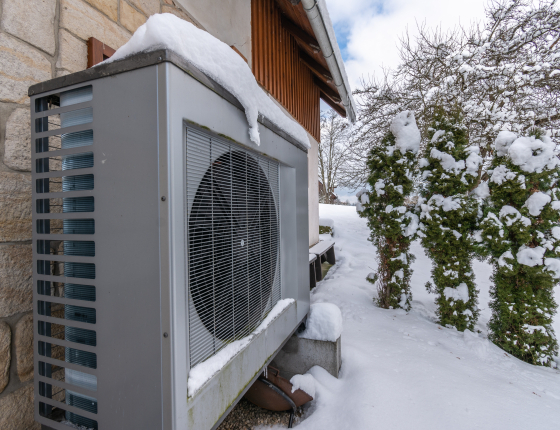
At the heart of CEE’s vision for decarbonizing homes in Minnesota is an air source heat pump (ASHP) that provides affordable and reliable warmth and comfort while reducing emissions to meet state goals.
CEE has spent over ten years analyzing, supporting, and advocating for ASHPs through our research efforts, lending programs, collaborative leadership, market acceleration success, and policy work. These efforts, and those of many others, have significantly increased the affordability of ASHPs in Minnesota through increased efficiency, lower operating costs, and steadily declining upfront costs.
The Power of Efficiency
Instead of burning fuel to produce heat, like a natural gas or propane furnace, ASHPs transfer heat from one area to another. They move heat rather than create heat. This gives heat pumps a significant efficiency advantage over other heating sources because, in most conditions, they can get more energy out of the process than they put in.
Over time, technological advances have increased the amount of heat ASHPs can extract and move from colder outside temperatures. Twenty years ago, ASHPs only worked in more temperate or southern climates like Florida where they provided efficient air conditioning and some heating in mild temperatures. Now, thanks to rapid technological improvements, heat pumps can produce the same heating output as a gas furnace at increasingly colder temperatures while using significantly less energy.
Using Less and Paying Less
Higher efficiency means using less energy to get the same results. Paying less for that energy completes the equation for increasing affordability, underscoring the importance of the rates that utilities charge to customers.
Xcel Energy’s recently approved electric space heating rate makes dual fuel systems, with an efficient ASHP and natural gas furnace backup, cost-competitive to operate for heating and cooling compared to a natural gas furnace and standard central air conditioning (AC) unit. The chart to the right shows that customers can pay less at increasingly colder temperatures with a dual fuel system. The switchover temperature is the outdoor air temperature at which the heating system switches from the heat pump to the natural gas furnace backup.
This example affirms at the household level what we discussed in Part One highlighting the emission reduction benefits and lower costs of dual fuel applications at a broader scale. It’s important to note that not every utility in Minnesota has space heating rates that reflect the benefits of ASHPs like Xcel Energy’s rate. Additional work is needed to make sure all Minnesotans can pay less through dual fuel ASHPs.
Buying the Better Option
Technological advancements have made ASHPs more efficient and modernizing utility rates have made ASHPs more affordable to operate once the heat pump is installed. Reducing the upfront cost of ASHPs completes the package to make heat pumps increasingly affordable for Minnesotans.
Utility, state, and local efficiency programs offer rebates to lower the upfront investment in a heat pump. Through our Efficient Technology Accelerator work, CEE collaborates with utilities, contractors, distributors, and manufacturers to advance ASHP applications and approaches that offer affordable solutions to meet a range of customer needs and budgets.
Replacing or installing a big appliance like an air conditioner or furnace presents a significant upfront cost for any household no matter what product they buy. Through technological advances and smart energy policy, ASHPs are an increasingly affordable option to heat and cool homes in Minnesota while reducing emissions.