This post complements our quarterly research newsletter, which features updates on CEE's research projects. Sign up to get this information in your inbox.
Mankato ERV Field Site Monitoring
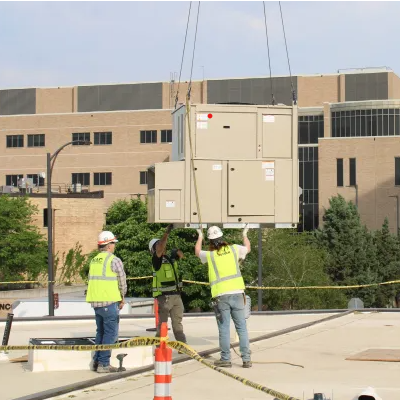
Background: As part of the Next Gen Rooftop Unit (RTU)’s mission to gauge the efficacy of high-efficiency HVAC systems in real-world conditions, the team field-monitored and analyzed an enthalpy wheel energy recovery ventilator (ERV) section on a dedicated outside air system (DOAS) located on a low-rise commercial building in Mankato, MN, over the course of 2024. ERVs save energy in buildings by reducing the amount of energy needed to condition incoming ventilation air. The DOAS on this building was configured to provide a constant volume of 70°F supply air whenever the building was occupied.
Update: Field-monitoring and data analysis of the ERV is complete and a final report pending. For the duration of the monitoring period, the building was occupied for one-third of all hours, and the ERV was in energy recovery mode about 75% of the occupied time and in economizing mode for the remaining 25%. The ERV saved 2,237 therms of gas and 2,692 kWh of electricity compared to a DOAS without an ERV. Combining an ERV with the DOAS met 50% of the ventilation heating load and 28% of the ventilation cooling load via energy recovery. The final report is expected to be published on the Next Gen RTU website in the coming weeks.
Learn more about Next Gen RTU projects
Minnesota's Efficient Technology Accelerator is funded by investor-owned utilities and administered by the Minnesota Department of Commerce, Division of Energy Resources.
Heat Pump Rooftop Unit Demonstration (CalNEXT)
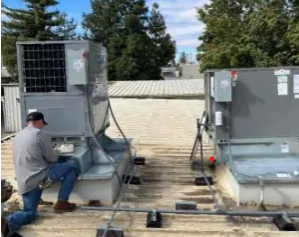 Background: CEE collaborated with the UC Davis Western Cooling Efficiency Center on a CalNEXT project focused on packaged rooftop units (RTUs) and their potential to contribute toward meeting California's ambitious energy and carbon goals by converting space heating from natural gas to electricity. The project team set out to characterize installed heat pump RTU system performance and savings relative to a conventional baseline system for both standard efficiency and high-efficiency RTUs. Installed performance data would be used to recommend strategies for economically and environmentally optimized RTU operation that meets conditioning loads.
Update: The project is complete, and a final report is available on the Next Gen RTU website, a CEE-led initiative under Minnesota’s Efficient Technology Accelerator program. When comparing the performance of the heat pump RTUs and the gas-fired standard unit, the heat pump units demonstrated significant potential to reduce energy use, operating costs, and greenhouse gas emissions. Both heat pump RTUs exhibited on-site reductions in energy use and greenhouse gas emissions of more than 50% compared to the gas-fired RTU. The cost savings for the high-efficiency heat pump RTU was about 10% compared to the gas-fired unit versus 3% for the standard-efficiency heat pump compared to the gas-fired unit.
Southern California Edison Company, on behalf of itself, Pacific Gas and Electric Company, and San Diego Gas & Electric® Company has contracted with Energy Solutions to design and implement the CalNEXT program.
Hennepin County Weatherization & Electrification Action Plan
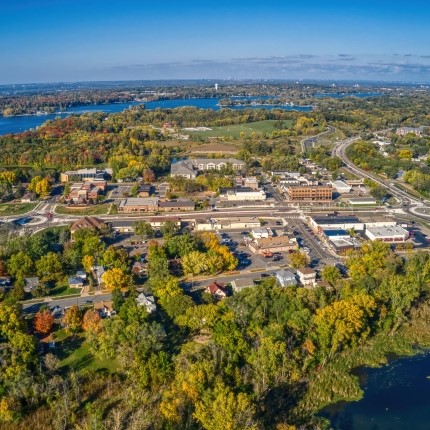
Background: Hennepin County has adopted an ambitious goal of net-zero greenhouse gas (GHG) emissions by the year 2050. To make this possible, the 1–4 unit residential building sector will need to drastically reduce its reliance on natural gas. In an extremely cold climate with relatively low natural gas prices, this is no small challenge. Hennepin County enlisted Center for Energy and Environment to quantify the financial, labor, and emissions implications of weatherizing and electrifying all 1–4 unit homes within the county limits. CEE was also tasked with identifying specific actions the County can take to equitably accelerate this transition.
Update: The report is being finalized for the County and will be published early this spring. To inform recommendations for the County, the team built a high-resolution modeling framework, performed spatial analysis to locate where investments yield the greatest climate and equity benefits, and gathered stakeholder input. The study found that three upgrades deliver nearly all technically achievable GHG reductions in this building set: comprehensive weatherization, all-electric or dual fuel heat pumps, and heat pump water heaters. Deploying these measures across all homes reduces residential emissions by roughly 73–99% by 2050 in modeled scenarios. Reaching net-zero in this sector requires weatherizing and electrifying approximately 12,800 homes per year. The study details tactical recommendations that leverage existing programmatic and policy successes to enable decarbonization at this scale.
This study was funded by Hennepin County.
New Website Features for CEE's Research
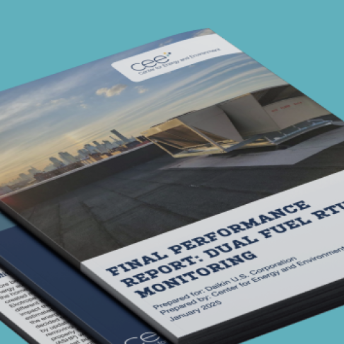
Update: As part of a recent refresh to the CEE website, we are happy to announce new user features that make it easier to browse, find, and interact with CEE’s current and completed research projects and our extensive findings. Visitors to the website are now able to search through research projects and reports and case studies by technology type, including cooling, electrification, heating, lighting, weatherization, and windows, or by building type, including commercial, industrial, multifamily, and residential. Our updated Reports & Insights page displays featured findings on innovative energy efficiency technologies. New landing pages for research reports break down objectives, scope, benefits, and results, so readers can easily identify important takeaways and engage further with CEE’s work.
MEDIA CONTACT
Tim Hanrahan, thanrahan@mncee.org